Tuesday, 18 October 2022

,

By Stijn Mitzer and Joost Oliemans
 
Turkmenistan has accumulated an exotic arsenal of armoured fighting vehicles (AFVs) acquired from a colourful range of countries worldwide. Intriguingly, at least some of those acquisitions appear to stem from an intention of increasing ties with a particular country rather than of actually fulfilling a genuine military requirement for that type of equipment. This 'friendship through arms' policy comes at the cost of an increasingly complicated logistic system that by now has to source spare parts from nine different countries for Turkmenistan's fleet of infantry mobility vehicles (IMVs) alone!

Monday, 17 October 2022

,

By Stijn Mitzer and Joost Oliemans

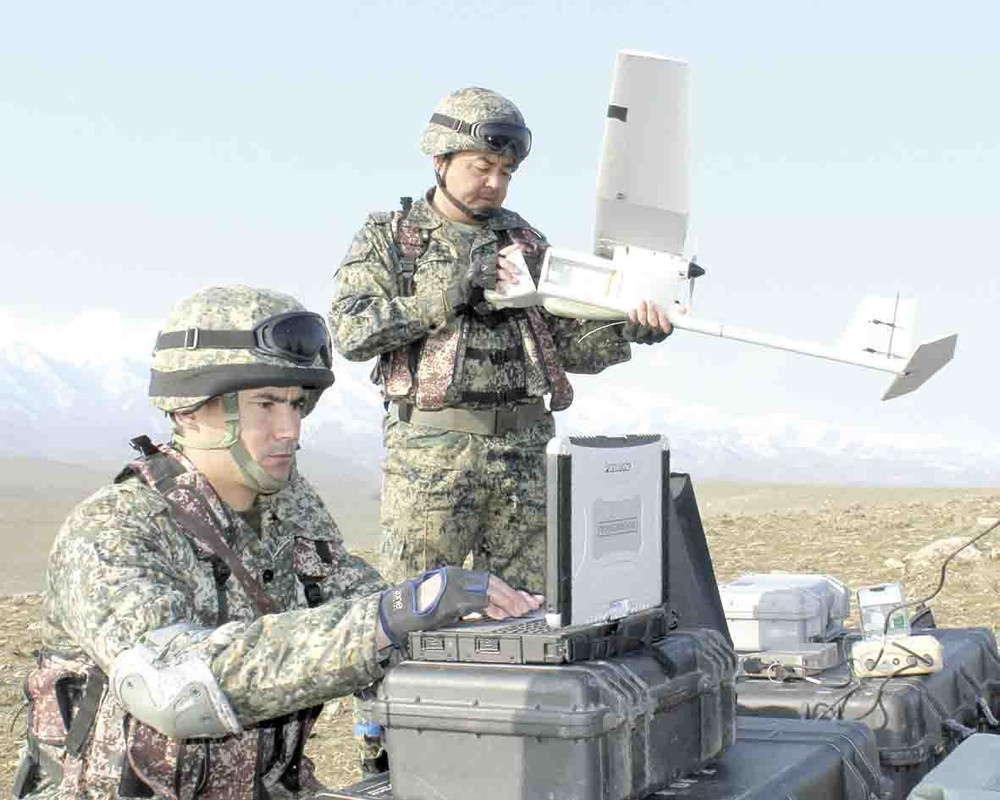
The Central Asian region isn't exactly well-known for its armed-drone prowess. Kazakhstan and Kyrgyzstan currently operate small numbers of unmanned combat aerial vehicles (UCAVs), with Kyrgyzstan having entered the age of drone-powered warfare only in late 2021. [1] Whilst Uzbekistan possesses a modest unmanned aerial reconnaissance capability in the form of several RQ-11 Ravens received from the US in 2018, it can be argued that only one Central Asian country has been constantly expanding its unmanned arsenal to keep up with the newest trends: Turkmenistan.
,

By Stijn Mitzer and Joost Oliemans

Vietnam has sought to address its security requirements by fielding a large military apparatus equipped with mostly Soviet-era weaponry that can be quickly reinforced by a massive reserve force armed with anything from World War II-era Soviet rifles to U.S. Main Battle Tanks dating from the 1960s. Modern equipment is relatively lacking in the inventory of the Vietnamese People's Army (VPA), with Vietnam instead preferring to upgrade existing weaponry to keep it combat effective in the 21st century. A prime example of this is the T-54M3 tank upgrade project.

Wednesday, 12 October 2022

,

By Stijn Mitzer and Joost Oliemans

In November 2021 it was announced that Kazakhstan had signed a contract with Turkish Aerospace Industries (TAI) for the delivery of three TAI Anka unmanned combat aerial vehicles (UCAVs). [1] Their purchase comes some five years after the Kazakh Air Force first acquired an armed drone capability in the form of four Wing Loong Is from China. [2] Rather than acquiring additional Chinese-made UCAVs, in 2021 Kazakhstan thus turned to Türkiye to press on with its armed drone programme. Other suppliers of UAVs to Kazakhstan are Israel and Russia, which both have delivered a number of reconnaissance UAVs.

Tuesday, 11 October 2022

,

By Stijn Mitzer and Joost Oliemans
 
The Republic of China, more commonly referred to as Taiwan, continues to invest billions into its domestic arms industry to safeguard R&D and production capabilities. While Taiwan is already self-sufficient in the design and production of most weapons systems or well on its way towards attaining such a capacity, the nation still makes regular purchases from the United States, its biggest supplier of arms and munitions. Recent purchases have included 108 M1A2T MBTs, 29 M142 HIMARS MRLs along with 84 ATACMS SSMs and 864 guided rockets, and Harpoon coastal defence missile systems. [1] [2] The latter two systems will serve alongside their Taiwanese-designed counterparts.

Monday, 10 October 2022

,

By Stijn Mitzer and Joost Oliemans

Though home to elements of the 17th Army Corps of the Central Asian Military District, Kyrgyzstan inherited little in the way of (modern) military equipment after the collapse of the Soviet Union. In fact, it can be argued that Kyrgyzstan was the worst off of all post-Soviet states when it comes to the military assets they inherited (with the exception of the Baltic states). With little investments having been directed to the Kyrgyz Army since, the country's inventory in many ways resembles that of the Soviet Army during the late 1970s. The acquisition of three Bayraktar TB2 UCAVs for the State Border Guard in 2021 represents the biggest military investment by Kyrgyzstan so far, and these were used with high effect during the September 2022 border skirmishes with Tajikistan. [1]

Sunday, 9 October 2022

,

By Stijn Mitzer and Joost Oliemans
 
Yurdumuzu dünyanın en mamur ve en medeni memleketleri seviyesine çıkaracağız – We shall raise our country to the level of the most prosperous and civilized nations of the world. (By Mustafa Kemal Atatürk)
 
Istanbul's intercontinental Marmaray Line has been hailed as a modern-day Silk Road. Connecting the European and Asian sides of Istanbul via a tunnel running underneath the Bosphorus, the Marmaray is a modern engineering marvel that has drastically improved transportation in the whole of Istanbul by the number of stations it attends to and its connection with other modes of transportation including the metro, tram, and bus rapid transit. The 76.6km-long commuter line has 43 stations, fourteen of which are located in the European part of Istanbul.