Showing posts with label L-39. Show all posts

Saturday, 8 January 2022

,

By Lukas Müller in collaboration with Stijn Mitzer
 
This is an updated and expanded version of an article that was first published in the August/September 2020 newsletter of the Asian Air Arms Research Group. The article also updates information on Afghan L-39s featured in the author's book Wings over the Hindu Kush.
 
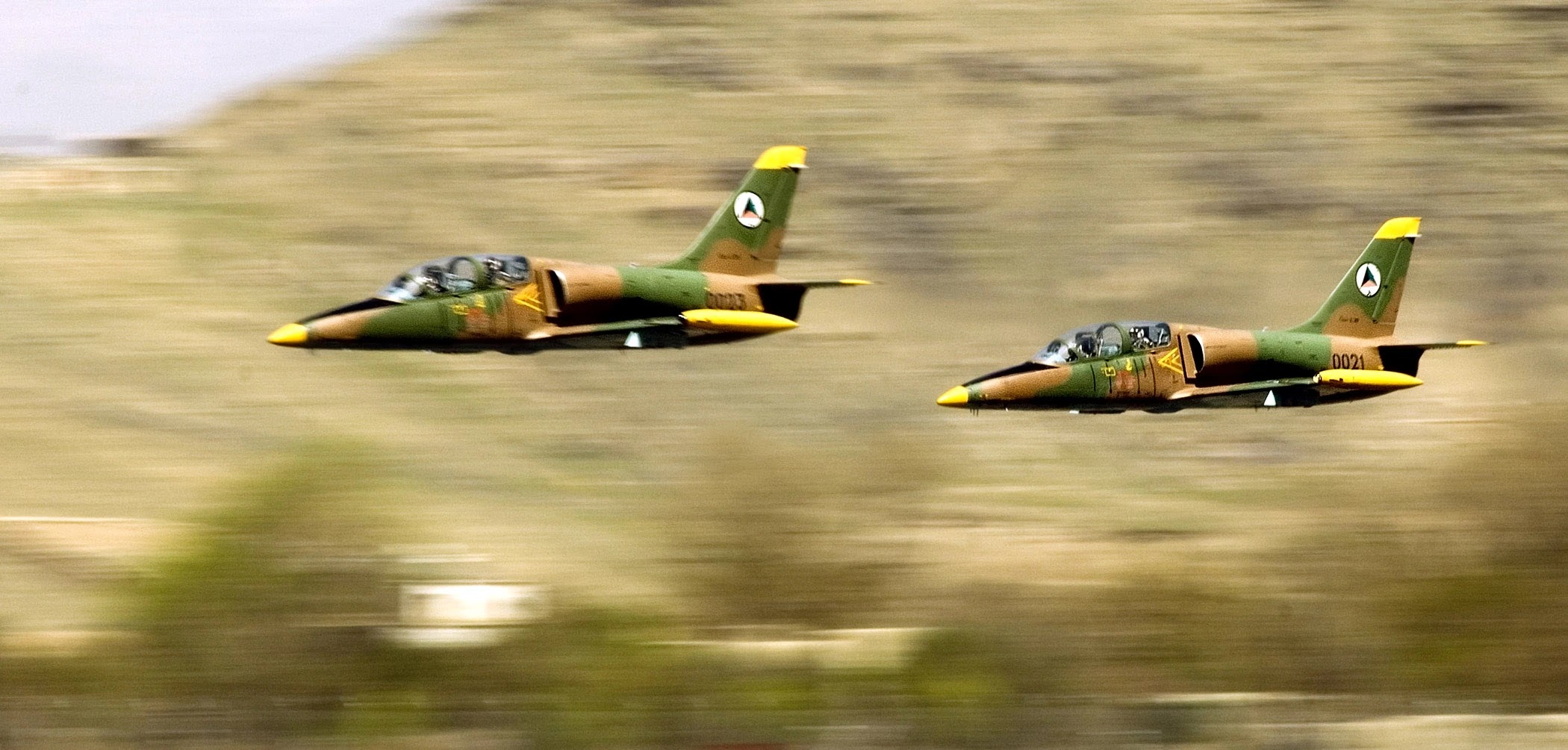
The Czechoslovak-made L-39 Albatros jet trainer was widely exported and enjoyed a long and successful career in service of many countries around the globe. Afghanistan received its first L-39s in 1977 with the last two examples being withdrawn only in the late 2000s or early 2010s, after at least 30 years of service. The story of Afghan L-39s might not be over yet, though: in December 2021, mechanics at Kabul airport, now under the command of the Taliban, began testing the engines of the remaining L-39s, with a clear ambition of bringing the long-grounded jets back to service. [1]

Thursday, 9 December 2021

,

By Stijn Mitzer and Joost Oliemans
 
A report by Al Jazeera from Kabul International Airport (IAP) shows that the new Afghan Air Force is currently working on introducing a fast jet capability to its air force. [1] The footage shows an L-39 undergoing an engine test after languishing in storage at Kabul IAP since the early 2010s. [2] Even though the United States saw little use in the operation of Mi-24 attack helicopters and L-39C jet trainers by the Afghan Air Force, both types were maintainted in operational condition, even though the L-39s are not believed to have flown in the past several years.

Thursday, 15 January 2015

,

 
By Stijn Mitzer and Joost Oliemans


To everyone's surprise, the Syrian Arab Air Force (SyAAF) has been able to maintain a high pace of operations in the now almost four-year long war. Orginally destined to engage in a fierce but short war with Israel, it never anticipated to fight what is essentially a war of attrition between the regime and its adversaries, and has found its role in the conflict through trial and error. The SyAAF saw a large part of its aircraft and helicopters upgraded in the Ukraine and Russia before and during the Syrian Civil War, and as all aircraft were safely returned, the SyAAF has been able to enjoy a "fresh start".